
- nl
- en
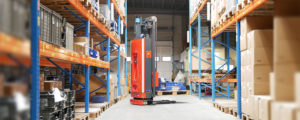
Automated Guided Vehicles (AGVs) offer numerous benefits for warehouses and production facilities. They improve efficiency through more reliable and consistent material flows, reduce labor costs through automation, increase workplace safety and minimize human errors and fatigue. This results in a reliable and optimized logistics operation.
Mabo Automation provides a wide range of AGVs, each designed for specific logistical needs:
Stacker: ideal for stacking pallets on the floor or in racks, perfect for warehouse management.
Reach Truck: suitable for handling variable pallets in production and warehouse environments.
Counterbalance: designed for block stacking tasks, building pallet towers in an efficient block stack configuration.
VNA (Very Narrow Aisle): optimized for narrow aisles with double-deep reach, ideal for compact storage.
Double Deep: increases storage capacity by stacking pallets up to two deep.
Sideloader: perfect for long loads and narrow aisles, suitable for specialized logistics.
Transporter: designed for efficient transport of goods within facilities.
AMR: an Autonomous Mobile Robot (AMR) for seamless movement of goods between workstations.
Discover all our different mobile robots here.
Mabo Automation uses a wide range of navigation technologies tailored to your specific needs:
SLAM Navigation: uses environmental features for flexible movement.
Laser Navigation: provides high precision using reflectors.
Vision-Guided Navigation: uses cameras for dynamic route planning.
GPS/RTK: suitable for outdoor and large-scale applications.
UWB Navigation: ultra-wideband for accurate positioning.
Optical Navigation: follows visual markers for flexible routes.
Induction Navigation: uses embedded wires for reliable guidance.
Magnet Navigation: uses magnetic strips for easy implementation.
Laser navigation with reflectors uses a laser on the AGV that sends signals to fixed reflectors to calculate the exact position. This technology offers unparalleled precision and is ideal for structured environments like warehouses where accurate pallet placement is essential.
An AGV (Automated Guided Vehicle) follows fixed, predefined routes and often requires infrastructure such as magnetic strips or reflectors. An AMR (Autonomous Mobile Robot) navigates independently using sensors, cameras, and maps providing greater flexibility in dynamic environments.
Yes, Mabo Automation’s AGVs can be adapted for refrigerated and freezer environments down to -25°C. Thanks to specially designed components and robust constructions. They operate reliably in extreme conditions.
Depending on the model our AGVs can place pallets at a height of up to 14 meters, ideal for high racking in modern warehouses.
Yes, we offer advanced fleet management software that allows you to monitor, manage, and optimize performance in real-time for maximum efficiency.
Absolutely. Our AGVs seamlessly integrate with existing Warehouse Management Systems (WMS) and Enterprise Resource Planning (ERP) systems, ensuring streamlined processes and data exchange.
Contact us for an introductory meeting. We will analyze your logistical needs and conduct a feasibility study to develop a tailored solution.
The project typically takes 6 to 8 months, with on-site implementation lasting 2 to 3 weeks. This depends on the complexity, customization, and environmental factors.
LiFePO₄ batteries offer enhanced safety, a longer lifespan, and faster charging cycles, making them ideal for intensive applications.
With our layout editor module, you as a customer can simulate, plan, and adjust routes within your facility. This ensures optimal logistical flows and efficiency.
We offer comprehensive aftercare, including maintenance, software updates, remote monitoring, and on-site support to ensure optimal performance.
Explore our aftersales service here.
Prior to starting a project, we analyze your logistics flows to identify bottlenecks, optimize processes, and ensure the compatibility of AGVs.
Our implementation process includes:
Analysis: Assessment of logistics requirements.
Design: Development of a tailored solution.
Simulation: Testing of routes and workflows.
Development: Construction of the AGV system.
Testing: Validation of functionality.
Installation: On-site implementation.
Training: Education and training of your team.
Yes, our AGVs can integrate with existing conveyors, wrapping stations and other automated systems to enable a fully automated workflow.
An AGV system requires minimal infrastructure such as power supply, communication connections and suitable floor conditions.
Mabo Automation analyzes your current logistics flows and designs AGV solutions such as the Mabo Stacker, Sideloader or one of our other models to increase efficiency, save space and reduce operational costs. Our in-house R&D and project management ensure solutions that are perfectly tailored to your needs.
Yes, we offer several models specifically designed to handle long and heavy loads in all directions. This ensures space savings and efficient transport in warehouses and production facilities.
We offer a fully in-house process from analysis and design to installation and training. Our project engineers ensure seamless integration of AGVs with your existing systems, such as conveyors or WMS, to create a streamlined workflow.
The Mabo AMR is an autonomous mobile robot that effortlessly transports goods between workstations. Thanks to advanced sensors and flexible navigation it provides an efficient alternative to traditional transport systems.
Our AGVs are equipped with advanced sensors and technologies such as lidar navigation to detect obstacles and prevent accidents. We also conduct analyses to minimize risks and achieve the appropriate performance level, ensuring a safe working environment in warehouses and production facilities.
Yes, Mabo Automation offers customized AGVs. Our team of engineers works closely with you to develop solutions tailored to your unique logistics challenges, such as narrow aisles or heavy loads.
Regular maintenance, such as replacing oils and lubricants extends the lifespan of AGVs. Mabo Automation offers flexible maintenance contracts (Bronze, Silver, Gold) to minimize downtime and optimize performance.
Our in-house production and project management enable rapid innovation, high quality, and flexible customization. This ensures AGVs that are perfectly tailored to your logistics needs.
The Stacker is designed for efficient pallet handling in narrow aisles allowing you to make optimal use of the available space in your warehouse.
The costs vary depending on the complexity, type of AGV, and level of customization. Contact us via the following form for a tailored quote and feasibility study.
SLAM stands for Simultaneous Localization and Mapping. It is an advanced navigation technique that allows a robot or vehicle to orient itself while simultaneously building a map of its environment. This enables the system to independently determine its location and the best path to move without requiring a pre-existing map.
Yes, AGVs are increasingly being used in the food industry. They can safely and efficiently transport raw materials, packaging materials and finished products without direct human contact, contributing to hygiene, consistency, and food safety.
Additionally many AGVs are designed with materials and finishes that are easy to clean ensuring they meet the strict requirements of food processing and logistics.
Can’t find your question? Contact Mabo Automation via the button below. Our team will answer your questions about AGVs, warehouse optimization, or intralogistics as quickly as possible!
To provide the best experiences, we and our partners use technologies like cookies to store and/or access device information. Consenting to these technologies will allow us and our partners to process personal data such as browsing behavior or unique IDs on this site and show (non-) personalized ads. Not consenting or withdrawing consent, may adversely affect certain features and functions.
Click below to consent to the above or make granular choices. Your choices will be applied to this site only. You can change your settings at any time, including withdrawing your consent, by using the toggles on the Cookie Policy, or by clicking on the manage consent button at the bottom of the screen.